Showing posts with label Green. Show all posts

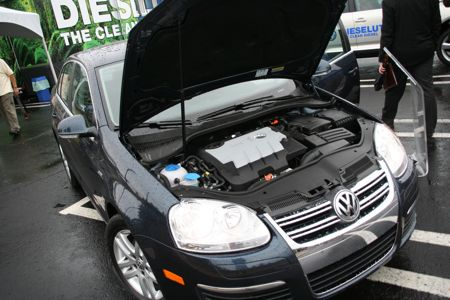
LA 2008: VW Jetta TDI named Green Car of the Year


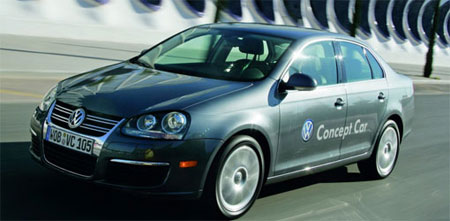
There are a few standouts in the emerging green sector of the U.S. auto market that are hitting the market in 2009. BMW's first clean diesel in the United States, the 335d, is one such vehicle that has torque-loving enthusiasts salivating, and General Motors' upcoming Saturn Vue is the first application of the 2-Mode hybrid system in a front-wheel drive vehicle. No green car discussion is complete without a mention of the smart fortwo, which sports the best mileage of any non-hybrid car available. Of course, the new Fusion Hybrid and Milan Hybrid from Ford are shaping up to be real contenders in the green mid-size sedan sweepstakes and they may take a chunk out of Camry hybrid sales when it finally debuts. Still, there is one '09 car that seems to offer the best of all worlds, with a relatively low starting price, excellent fuel economy and refined driving dynamics: The 2009 Volkswagen Jetta TDI. For these reasons, the oil-burner from Germany has been selected by Green Car Journal as the 2009 Green Car of the Year. We're not arguing with the decision, but you are, of course, free to make your voice heard in the comments section.

[ Via: Autoblog (Volkswagen) ]
[ Tag: 2009 green car of the year, 2009GreenCarOfTheYear, green car of the year, GreenCarOfTheYear, la, la 2008, la auto show, La2008, LaAutoShow, volkswagen jetta tdi, volkswagen jetta tdi green car of the year, VolkswagenJettaTdi, VolkswagenJettaTdiGreenCarOfTheYear, vw jetta green car of the year, vw jetta tdi, VwJettaGreenCarOfTheYear, VwJettaTdi ]

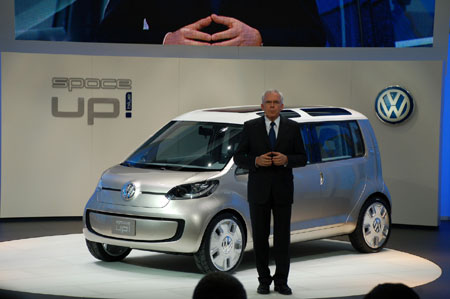
New VW Beetle could be North America's up! variant?


The VW Beetle is a cult favorite here in the States, but in Germany, it's not so well loved. That could be part of the reason why Volkswagen has been slow to produce a successor to the new Beetle, but word from Motor Trend is that two models could be coming shortly. The first Beetle will be based off the Gen-VI Golf and will hit production in 2010 or 2011.
Word out of Wolfsburg is that a second Beetle could be on the way as well, but this one would be based off the up! minicar. That would give VW a sub-brand Beetle lineup, kind of like what Toyota has with Scion, but with an eye on MINI buyers. The smaller up!-based Beetle would also be more true to the original Bug, which was a cheap and efficient "People's Car" with the engine out back (supposedly). Quality problems and a weak dollar have lead VW to struggle in the U.S. over the past few years, but an inexpensive, reliable car with top-notch fuel economy would go a long way toward reversing that trend.

[ Via: Motor Trend ]
[ Tag: Beetle,New Beetle,NewBeetle,up minicar,UpMinicar,Volkswagen,VW ]

Volkswagen releases three concepts... from 2028


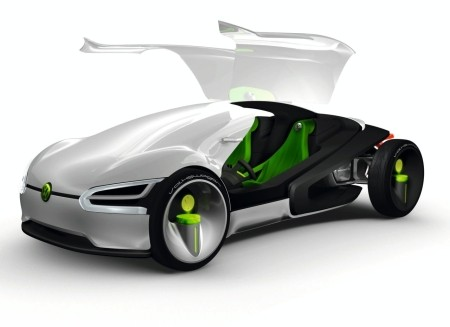
Click the above image of the Ego for more shots of VW's 2028 concepts
For years, Inquiring minds have been imagining what the world will look like in the not-too-distant future, and, as you're no doubt aware, our brains have a knack for envisioning more than our feeble hands can produce. That appears to be the case with Volkswagen and its look 20 years into the future of the automobile. So, with that in mind, what does VeeDub see as the future of transportation in twenty years? To begin with, customizable cars which can be summoned up in just minutes. Traveling alone? Choose the One, a single-seater, for the smallest footprint possible. Want to have some fun? Choose the aptly named Ego, a sporty two passenger coupe with an instant custom flame job. If you need to haul the whole clan, the future's family truckster VW Room needs no driver, leaving you with plenty of quality time with the kids.
Volkswagen envisions vehicles which communicate with each other, meaning that driver involvement is kept to a minimum, traffic is a thing of the past and accidents are completely avoided. Of course, no vision of the future would be complete without the elimination of fossil fuels, and VW sees to it that biofuels and electricity power the cars of the future. Interestingly, the not-so-futuristic up! concept is used as the starting point for the German automaker's future designs. Head on over to the micro-site for more.

[ Via: Volkswagen 2028 ]
[ Tag: 2028, future car, future cars, FutureCar, FutureCars, volkswagen, volkswagen 2028, Volkswagen2028, vw, vw 2028, vw ego, vw one, vw room, vw up, Vw2028, VwEgo, VwOne, VwRoom, VwUp ]

VW to fleet test Twin Drive Golf plug-in hybrid concept in 2010


Volkswagen CEO Martin Winterkorn has revealed a new concept today called the Golf Twin Drive. The Twin Drive is a plug-in electric hybrid that uses a powerful 82-hp electric motor and a 2.0L turbodiesel producing 122 hp. The electric motor is fed energy from a pack of lithium-ion batteries that can sustain the car's mobility for about 50 kilometers or 31 miles, after which the diesel engine will take over propulsion duties. While we do know the Twin Drive also features start-stop technology and regenerative brakes, we're still a bit unclear on how everything works. From the way it's been described in the news and VW's somewhat vague press release that we've translated from German, the gas and electric motors are completely isolated, with one unable to provide the other assistance under heavy loads like in the Prius or a typical parallel hybrid. At the same time, the Twin Drive Golf doesn't sound like a series hybrid in the same vein as the Chevy Volt, as the gas engine (or diesel in this case) is directly connected to the drive wheels. In other words, the engine onboard is not simply a range-extending generator supplying power to recharge the batteries like in the Volt. What the Twin Drive appears to be is a plug-in hybrid with a very robust electric drivetrain that's forced to drag around an internal combustion engine in case it gets too far away from home. Regardless, when we find out exactly how Twin Drive works, we'll let you know.
Volkswagen is developing the Twin Drive system with eight German partners and is planning a trial fleet of 20 Golfs outfitted with the system in 2010. The German government is along for the ride, and for a good bit of green PR, VW promises the the electricity used to charge the fleet of test vehicles will be generated from renewable sources like wind and solar power.

[ Via: Autoblog (Volkswagen) ]
[ Tag: plug-in hybrid, Plug-inHybrid, twin drive, TwinDrive, vw golf hybrid, vw golf twin drive, vw plug-in hybrid, vw twin drive, VwGolfHybrid, VwGolfTwinDrive, VwPlug-inHybrid, VwTwinDrive ]

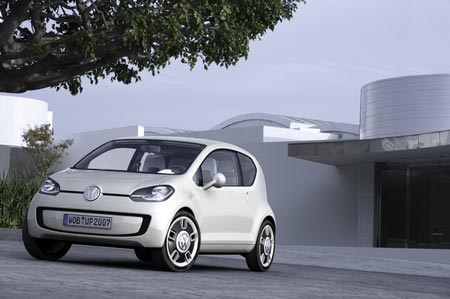
Production VW up! may drop rear engine and RWD


We'll admit to being a bit shocked that Volkswagen was even considering a move back to the rear-engine configuration it made fashionable all those years ago with its first vehicle, the ubiquitous Beetle, for the production version of its up! concept. Although we have some fondness in our hearts for the good ol' Bug and its backwards engine location, modern packaging constraints may force VW to ditch this idea for the production version of the up!, just like it did for the modern reincarnation of that first Vee Dub, the New Beetle. Out would go the uniqueness of the concept vehicle with this decision, but such is life in these days of platform sharing and cost considerations.
To go along with the previously noted nostalgia-crushing news, rumors indicate that both a 1.2-liter gasoline engine and a new diesel engine of the same displacement are expected, both offering just 55 horsepower. If this power level is accurate, at least the up! will share one thing with its Beetle forebear: really slow acceleration.

[ Via: Motor Authority ]
[ Tag: front engine, FrontEngine, rear engine, RearEngine, volkswagen, volkswagen up, VolkswagenUp, vw, vw up, VwUp ]

Volkswagen prices 2009 Jetta TDI from $21,990


Volkswagen revealed today that $21,990 will be the base price for its highly anticipated 2009 Jetta TDI, while the Sportwagen model will start at $23,590. This is extremely aggressive pricing on the part of Volkswagen that places the Jetta TDI in direct competition with the Toyota Prius, as eco-minded shoppers will surely cross-shop the two.
The TDI model will be the equivalent of the SE trim level for gas-powered Jettas. A 2009 Jetta SE 2.5L manual sedan starts at $19,990, which tells us that the high-tech, 50-state-compliant clean diesel engine is worth about a $2,000 premium. The Jetta TDI will, however, be available with either a manual or DSG transmission.
The EPA recently rated the 2009 Jetta TDI at 30 mpg city and 41 mpg highway, which were disappointing numbers for Volkswagen. It has since hired an independent, third-party certifier, AMCI, to ascertain what it refers to as the Jetta's "true fuel economy". AMCI came back with a better rating (surprise!) of 38 mpg city and 44 mpg highway. Whether or not you think it's fair for Volkswagen to go around the EPA in search of a higher fuel economy rating, we were just as surprised at how low the EPA numbers were. We're eager to get one in the Autoblog Garage ASAP for a review so we can test its "true fuel economy" for ourselves.


PRESS RELEASE

THE PEOPLE WANT BETTER FUEL ECONOMY WITH NO COMPROMISES
Volkswagen Jetta TDI starting at $21,990 and certified at 38/44 mpg

HERNDON, Va.-Volkswagen of America, Inc. today announced pricing for their eagerly anticipated Jetta TDI sedan and SportWagen starting at $21,990 and $23,590, respectively. Fuel efficiency, performance and convenience all come standard with the 50-state compliant Jetta sedan and SportWagen TDI, which meet the most stringent emissions standards in California and the world. Both models will be available this August.

"Our clean diesel vehicles offer consumers a true value with the fuel efficiency that drivers are looking for while providing power, utility and performance," said Mark Barnes, COO, Volkswagen of America, Inc. "The Jetta TDI's offer a no compromise alternative fuel driving experience."

While the Environmental Protection Agency estimates the Jetta TDI at an economical 29 mpg City and 40 mpg Highway, Volkswagen went a step further to show the true fuel economy of the Jetta TDI. Leading third-party certifier, AMCI, has tested the Jetta TDI and found it performed 24 percent better in real world conditions, achieving 38 mpg in the City and 44 mpg on the Highway.*

The Jetta TDI's come standard with Volkswagen's Prevent and Preserve Safety System, consisting of numerous standard safety features. Jetta TDI's include six airbags, with optional rear side airbags, and like all 2009 model year Volkswagens, Jetta TDI's also feature standard Electronic Stabilization Program (ESP) for added safety.
Also standard for 2009 is Volkswagen's carefree maintenance program, with this program there are no charges for the scheduled maintenance described in the vehicle's maintenance booklet for the length of the New Vehicle Limited Warranty-three years or 36,000 miles, whichever occurs first.

[ Via: Autoblog (Volkswagen) ]
[ Tag: 2009 jetta tdi, 2009JettaTdi, jetta tdi, jetta tdi price, JettaTdi, JettaTdiPrice, msrp jetta tdi, MsrpJettaTdi, volkswagen jetta tdi, VolkswagenJettaTdi ]

Volkswagen debuts zero-emission Tiguan HyMotion in the U.S.


Volkswagen has shown off its Tiguan HyMotion Fuel Cell Concept for the first time in California. The five-passenger SUV, based on the Volkswagen Tiguan, features a hydrogen fuel cell powering an electric motor. The electric motor may also pull power from a 6.8 Ampere-hour lithium-ion battery that is recharged by recuperating braking energy. The VW hybrid generates 107 horsepower under normal conditions. With assist from its auxiliary energy battery, the total output increases to 134 horsepower. According to VW, that is enough power to push the Tiguan HyMotion to 60 mph in about 14 seconds and a top speed is 93 mph.While the performance is less-than-stellar, you have to remember that the Tiguan HyMotion produces zero tailpipe emissions. Yes, the only thing coming out of the pipe is clean water vapor. It's a concept, however, so don't expect to see it in showrooms anytime soon.

[ Via: Autoblog (Volkswagen) ]
[ Tag: Concept, Electric, Hybrid, Hydrogen, HyMotion, Lithium battery, LithiumBattery, Tiguan, Volkswagen ]

VW to equip Golfs with smaller engines next year


We expect to see a the sixth-generation of Volkswagen's now iconic Golf model break cover soon enough, and now we are hearing rumors of some new powertrain options for the MkVI as well. According to German news site Automobilwoche, we should expect to see at least one engine of smaller displacement than the current 1.4-liter gasoline unit that powers the current Golf model in Europe. Interestingly, VW is said to be considering a possible three-cylinder engine for the base-model Golf, which could displace as little as one liter. Another possibility is a 1.2-liter version of the engine with four cylinders. To make the rumored 75 horsepower, we'd expect to see the German automaker continue its use of turbocharging, supercharging or both, as it does with some versions of the 1.4-liter engine already in use. As is usually the case, we're not holding our breath for these engines to make it stateside.


[ Via: Automotive News Europe ]
[ Tag: golf mkvi, golf vi, golf-mkvi, golf-vi, GolfMkvi, GolfVi, volkswagen, volkswagen golf, volkswagen-golf, VolkswagenGolf, vw, vw golf, VwGolf ]

VW and Sanyo hook up on lithium-ion battery development


Following the lead of Japanese manufacturers such as Toyota and Nissan, Volkswagen has announced a major deal with Sanyo to produce lithium-ion batteries. The two companies already have ties, as VW uses Sanyo's nickel-metal hydride batteries in its current hybrid vehicles, such as the upcoming Audi Q7 hybrid. Li-ion batteries are the current cream-of-the-crop when it comes to storing electricity and VeeDub has plans to begin offering vehicles with the high-tech copper tops as early as 2009.
Unlike Toyota and Nissan, which have created jointly run manufacturing plants with their battery suppliers, Sanyo will be going it alone with an 80 billion yen, or $769 million, investment in order to expand production of its li-ion batteries by 2015, at which time it plans on producing 15-20,000 units per year. Sanyo also happens to provide nickel-metal hydride batteries for the Ford Escape Hybrid and the Honda Civic Hybrid.
[Sources: Volkswagen, The Detroit News]
Press Release:
Volkswagen Working on High-Performance Energy Storage
Dynamic partnership between the Volkswagen Group and Sanyo

Wolfsburg, 28 May 2008 - Agreement has been reached on a co-operation which sees Volkswagen joining forces with Sanyo, one of the world's leading developers of rechargeable batteries, to work on new and extremely efficient high-performance storage systems based on lithium-ion technology.

"Our focus in future," says Prof Martin Winterkorn, CEO of the Volkswagen Group, "will be directed more strongly at making electrically powered automobiles alongside ones driven by more efficient combustion engines. Drivetrain electrification is the way forward if we wish to secure mobility in tomorrow's world. This will involve energy recovery. The whole idea will be to no avail, however, as long as we do not have powerful energy storage systems at our disposal and as long as vehicle operations are not in tune with customer demands. This cooperation is an important step for us," Winterkorn adds.Emissions-free travel in an all-electric operating modus is already possible today, though only at limited speeds and over short distances. That makes it all the more important to develop new accumulators with the capacity, size, weight and cost attributes which will enable them to be used more efficiently in tomorrow's automobiles. Lithium-ion technology, already very successfully used in communications electronics and portable computers, has the potential to satisfy even the particularly exacting demands placed on electro-traction systems in motor vehicles. Back in March, at the Geneva Motor Show, Volkswagen showcased its Golf TDI Hybrid design study, which demonstrated just how much potential for energy reduction there is when you combine high-tech-diesel, electric-drive and 7-speed-DSG technology. Conceived as a powerful full-hybrid vehicle, the Golf TDI Hybrid can be operated using combustion-engine power only or using a combination of combustion and electric drive or using E-drive – i.e. the powerful and energy-efficient combination of TDI technology and an electric motor. The A1 project quattro presented by Audi at the most recent Tokyo Motor Show features a powertrain already designed to cover a distance of 100 km using this innovative storage method. The Group hopes to be able to employ lithium-ion technology in its first vehicles by 2010.

[ Via: Autoblog (Volkswagen) ]
[ Tag: audi, audi hybrid, audi-hybrid, AudiHybrid, volkswagen, volkswagen hybrid, volkswagen-hybrid, VolkswagenHybrid, vw, vw hybrid, vw-hybrid, VwHybrid ]

Official EPA numbers posted for the '09 Jetta TDI - 30/41mpg


When we got our first chance to sample the new Volkswagen Jetta TDI last summer, VW of America CEO Stefan Jacoby indicated that the new compact diesel would achieve mileage in the 40mpg range. More recently, VW has been indicating that the Jetta TDI is capable of up to 60mpg on the highway. The first of the new fifty-state legal Jetta's were recently spotted on their way to dealerships and now the EPA has published official mileage numbers. Unfortunately those numbers don't quite match up with what VW has been claiming.
According to the official listings at FuelEconomy.gov, the 6-speed manual TDI managed 30mpg on the city cycle and 41mpg on the highway cycle. The combined number is 34mpg. Now those numbers are certainly respectable and nothing to sneeze at, but they fall well short of VW's predictions. Nonetheless, the TDI rates 41.7-percent better than the 2.5L five cylinder and 36-percent better than the 2.0 TFSI four cylinder. The big question is what will a diesel Jetta do in the real world? According to VW spokesman Keith Price Volkswagen's diesels typically do better in real world mileage than the EPA sticker values. VW, you know where to find our garage so we can judge for ourselves.
%Gallery-22061%

[ Via: FuelEconomy.gov ]
[ Tag: ]

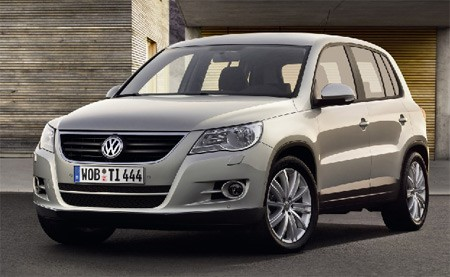
Volkswagen Tiguan diesel launch delayed in the U.S.?


All-time high gas prices have made Americans intensify their searches for top-shelf fuel economy, as evidenced by 15-year-old Geo Metros selling on eBay for $7,200. Apparently even capitalistic insanity isn't enough to convince Volkswagen to bring a diesel engine Stateside in the hotly anticipated Tiguan, as the ultra-efficient 2.0L oil-burner likely won't be available for MY 2009.
Part of the problem lies in the fact that the Tiguan is selling extremely well in Europe, which negates the need to rush additional models to the US, where a weak dollar is cutting into the German automaker's profits. VW is also trying to keep the price down on the new crossover, and diesel engines add thousands to the sticker. We wouldn't be surprised if the constant delays surrounding the 2.0L TDI have anything to do with the decision, either.
If a price war can break out on eBay in an effort to buy a turquoise 49 hp deathtrap, we're more than certain that Americans are willing to shell out $30k for an efficient CUV. Without a diesel powerplant, however, the Tiguan is just one more of the many mediocre-mileage tall wagons from which to choose.

[ Via: Winding Road ]
[ Tag: CUV, diesel, TDI, Tiguan, Volkswagen Tiguan, VolkswagenTiguan, VW ]

Volkswagen finishes up Jetta BlueTDI development, on sale this summer


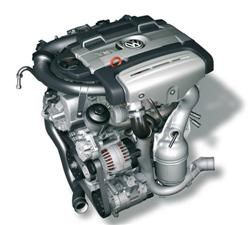
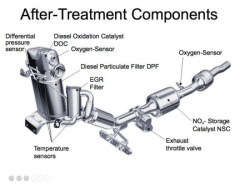
The new, fifty-state legal Jetta BlueTDI is finally done and it's coming soon. At the International Vienna Motor Symposium in Austria, Volkswagen announced that it's completed development on what they are calling the BlueTDI system for their US diesels. Like Mercedes (BlueTec) and BMW (BluePerformance), VW is adopting the Blue moniker for their cleanest, most efficient systems. The Jetta BlueTDI will be the first Tier2 Bin5 compliant diesels that doesn't have to use a urea injection system to meet the new NOx emissions standard. VW started with the updated 2.0L TDI that was launched in the European Tiguan last fall. Individual cylinder pressure sensors were added that allow the engine management system to optimize the fuel injection pulses to keep combustion temperatures down. That helped VW eliminate 60-percent of the NOx emissions before you even get to the exhaust stream. The exhaust gas flowing from the 2.0L engine are low enough that VW was able to use a lean NOx trap to convert the remaining NOx to nitrogen and water. However, the larger 3.0L V-6 TDI that is coming in the Touareg and Audi Q7 at the end of the year will have to use urea injection. In addition to the NOx trap, there is a particulate filter to eliminate the soot often associated with diesel engines. The new Jetta will be able to get up to 60mpg when cruising on the highway, a boost of 12-percent over the last US-market Jetta TDI from 2006. The Jetta BlueTDI should be the first of the new round of diesels to come to market when it arrives later this summer. The first batch of cars should actually start arriving at US dealers in June, where they will be available for test drives through the summer before going on sale in September.
Vienna Motor Symposium 2008: BlueTDI development completed successfully
BlueTDI will debut midyear in North America

The U.S. version of the Jetta will be the first to use BlueTDI
Wolfsburg, 24 April 2008 - At the International Vienna Motor Symposium (24-25 April), Volkswagen is to introduce the production version of the BlueTDI, a next-generation turbo diesel developed especially for the North American market. The common rail engine is based on the high-tech TDI, which was first introduced in Europe in 2007 with the Tiguan. This engine already satisfies the Euro-5 standard that comes into effect in autumn 2009. In order to meet specific operating conditions in the U.S., this four-cylinder engine was redeveloped with internal engine modifications and a NOx trap.

Background information: Five U.S. states1, including California, currently have the strictest emissions standards in the world (BIN5/LEV2). In spite of variations in fuel quality, which are more dramatic in the U.S. than in Europe, the new BlueTDI meets these emissions standards. The engine will debut in the U.S. Jetta this summer. For years, the Limousine has been the most popular and successful European-manufactured car on the American market, especially as a diesel.

The Jetta BlueTDI will debut as one of the cleanest and most economic cars of its class in the world. In the run-up to the Vienna Motor Symposium, Dr. Ing. Jens Hadler, Director of Volkswagen Powertrain Development comments, "high fuel prices and a dramatic change in environmental consciousness means that diesel is becoming more and more attractive for American drivers every day." Dr. Hadler continues, remarking, "this is why many customers, especially in California, have been waiting for a super-clean diesel like our BlueTDI. I think this motor will help the diesel get its big break in America because it consumes so little and yet can go such long distances on a single fill-up. And in a country as big as the United States, this is a priceless advantage. On the highway, for example, this engine can reach up to 60 miles per gallon2. This is an improvement of 12 percent over its predecessor, which had a lower capacity and higher emissions."

A key aspect in the development of the BlueTDI (2.0 litre engine displacement, 103 kW/140 PS, 320 Nm) was the reduction of nitrogen oxide emissions (NOx); the American BIN5/LEV2 standards stipulate a nitrogen oxide limit of only 0.05 g/mile. The engineers in Wolfsburg met this limit and the general reduction of raw emissions by using internal engine modifications, some of which are unique worldwide, and implementing the maintenance-free NOx trap.

These internal engine changes include modifications to the design of the injection system of both the American and European TDI as well as the implementation of cylinder pressure sensors. This allows for a completely new type of cylinder pressure-based combustion control, which is both faster and tailored to each specific cylinder. Also new on-board: an optimised high-pressure injection pump. Another unique feature is the combination of a high-pressure exhaust gas recirculation system with additional low-pressure exhaust gas recirculation. This dual exhaust gas recirculation (dual circuit EGR) is an effective means of reducing nitrogen oxides in the engine. The dual circuit EGR system alone reduces NOx by up to 60 percent.

Outside of the engine, it is the NOx trap – connected downstream of the oxidation catalytic converter and the particle filter – that reduces nitrogen oxide to an absolute minimum. Implemented together, these measures reduce nitrogen oxide emissions by 90 percent. Drive the Jetta BlueTDI and you will be driving one of the most economical and environmentally-friendly cars in America.

1) = BIN5 states: California, Massachusetts, Maine, New York and Vermont.
2) = MPG (miles per gallon) is the standard range specification in the U.S. for describing fuel consumption.


[ Via: Autoblog (Volkswagen) ]
[ Tag: bluetdi, bluetdi-jetta, jetta, jetta bluetdi, jetta diesel, jetta tdi, JettaBluetdi, JettaDiesel, jettatdi ]